Choosing Executors and Trustees: The Most Important Decision in Your Estate Plan (And How to Get It Right)"
You've done everything right.
You have a will. You've named guardians for your kids. You've set up a trust. You've designated beneficiaries.
But here's the question nobody asks until it's too late: Who's actually going to EXECUTE all of this?
Because here's the hard truth: Choosing the wrong executor or trustee can destroy your estate plan—and your family.
I've heard the horror stories. Siblings stop speaking. Physical fights break out. Assets sit frozen for years. Legal fees drain the estate. All because someone chose an executor based on feelings instead of qualifications.
Today, we're fixing that.

What Executors and Trustees Actually Do
Let's start with the basics.
What is an Executor?
An executor (sometimes called a "personal representative") is the person responsible for settling your estate after you die.
Their job includes:
✅ Filing your will with the probate court
✅ Inventorying your assets (bank accounts, real estate, investments, personal property)
✅ Paying your debts and taxes (yes, Uncle Sam still wants your tax return filed for the portion of the year you lived)
✅ Distributing assets to beneficiaries according to your will
✅ Handling disputes or claims against the estate
✅ Closing accounts and tying up loose ends
Timeline: This process typically takes 6 months to 2 years (sometimes longer if the estate is complex or contested).
Skills Needed:
Financial literacy (managing assets, paying bills, filing tax returns)
Attention to detail (tracking paperwork, deadlines, court filings)
Interpersonal skills (communicating with beneficiaries, dealing with conflict)
Time availability (this is not a passive role)
What is a Trustee?
A trustee manages assets held in a trust—either during your lifetime (if you become incapacitated) or after your death.
Their job includes:
✅ Managing trust assets (investments, real estate, business interests)
✅ Distributing funds to beneficiaries according to trust terms
✅ Filing trust tax returns
✅ Making financial decisions in the best interest of beneficiaries
✅ Maintaining records and providing accounting to beneficiaries
Timeline: Trusts can last for years or even decades (e.g., until a child turns 25, or for the lifetime of a surviving spouse).
Skills Needed:
Investment knowledge (managing trust assets for long-term growth)
Fiduciary responsibility (acting in beneficiaries' best interests, not their own)
Conflict resolution (navigating family dynamics and competing interests)
Long-term commitment (trustees may serve for 10, 20, or 30+ years)
Key Difference: Executor vs. Trustee
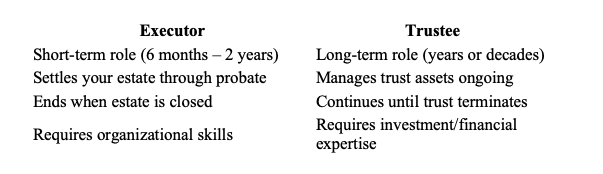
Important: The same person can serve as BOTH executor and trustee—but they don't have to be.
How to Choose the Right Executor
Choosing an executor is not about picking your favorite person or the oldest sibling.
It's about choosing someone with the skills, availability, and temperament to do the job well.
Qualities to Look For:
1. Financial Literacy
Your executor will be managing money—paying bills, filing tax returns, liquidating assets, distributing inheritances.
Ask yourself:
Does this person manage their own finances well?
Can they handle complex financial tasks (tax forms, investment accounts, real estate transactions)?
Are they comfortable working with accountants, attorneys, and financial advisors?
Red Flag: Choosing someone who's bad with money, chronically disorganized, or financially irresponsible.
2. Attention to Detail
Executors deal with mountains of paperwork—court filings, inventories, accountings, beneficiary notices, tax returns.
Ask yourself:
Is this person detail-oriented and organized?
Can they meet deadlines and follow through on tasks?
Will they keep thorough records?
Red Flag: Choosing someone who's chronically late, forgetful, or overwhelmed by administrative tasks.
3. Availability and Time
Being an executor is a part-time job for 6 months to 2 years.
Ask yourself:
Does this person have the TIME to dedicate to this role?
Do they live nearby (or can they travel as needed)?
Are they in a life stage where they can take this on (not overwhelmed with young kids, elderly parents, demanding career)?
Red Flag: Choosing someone who lives across the country, travels constantly for work, or is already stretched too thin.
4. Interpersonal Skills
Executors often mediate family conflict—especially when beneficiaries disagree about asset distribution, sentimental items, or the executor's decisions.
Ask yourself:
Can this person handle conflict calmly and fairly?
Are they respected by other family members?
Will they communicate clearly and regularly with beneficiaries?
Red Flag: Choosing someone with a history of family conflict, poor communication, or favoritism toward certain family members.
5. Trustworthiness
Your executor will have access to all your assets—bank accounts, investments, real estate, personal property.
Ask yourself:
Do I trust this person completely with my money and belongings?
Will they act in the beneficiaries' best interests—not their own?
Are they honest, ethical, and responsible?
Red Flag: Choosing someone with a history of financial issues, addiction, legal problems, or dishonesty.
Common Mistakes When Choosing an Executor
❌ Choosing based on birth order ("I'll pick my oldest child because that's fair")
✅ Choose based on COMPETENCE, not age or fairness
❌ Choosing to avoid hurt feelings ("I don't want to offend my sister")
✅ Choose the person best suited for the job—you can explain your reasoning in a letter
❌ Choosing someone too old or in poor health ("I'll pick my 80-year-old spouse")
✅ Choose someone likely to outlive you and be capable when the time comes
❌ Not naming an alternate ("I only need one executor")
✅ Always name at least one alternate in case your first choice can't serve
How to Choose the Right Trustee
Trustees have even more responsibility than executors—because they're managing assets for YEARS, not months.
Qualities to Look For:
1. Investment and Financial Expertise
Trustees must manage trust assets (stocks, bonds, real estate, business interests) and make decisions that balance growth with preservation.
Ask yourself:
Does this person understand investing and financial markets?
Can they work with financial advisors and make informed decisions?
Do they have experience managing complex assets?
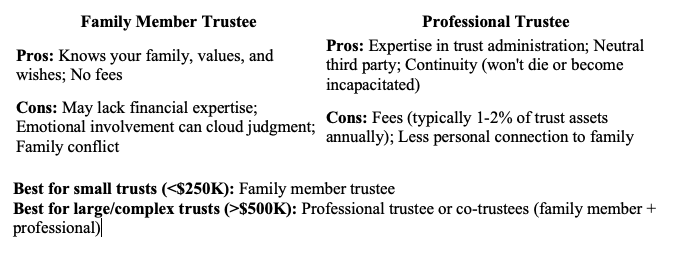
Consider: If your trust holds significant assets ($500K+), consider a professional trustee (bank, trust company, or financial advisor) instead of a family member.
2. Long-Term Commitment
Trusts can last for decades. Your trustee needs to be in it for the long haul.
Ask yourself:
Is this person young enough and healthy enough to serve for 10, 20, or 30+ years?
Are they willing to commit to this responsibility long-term?
Red Flag: Choosing someone close to your own age or older—they may not outlive the trust term.
3. Fiduciary Mindset
Trustees have a legal duty to act in beneficiaries' best interests—not their own.
Ask yourself:
Will this person put beneficiaries' needs first?
Can they remain neutral in family conflicts?
Will they avoid self-dealing or favoritism?
Red Flag: Choosing a beneficiary as trustee (can create conflicts of interest).
4. Willingness to Serve
Being a trustee is a serious, long-term responsibility. Make sure the person you choose actually WANTS the job.
Ask yourself:
Have I discussed this with them?
Are they willing and able to take this on?
Do they understand what's involved?
Red Flag: Naming someone as trustee without asking them first.
Should You Choose a Family Member or Professional Trustee?
What Information Do Courts Provide?
Here's what most people don't know: Courts don't educate executors or trustees on how to do their job.
When you file a will with the probate court, most will provide:
✅ Instructions on how to open an estate
✅ Required forms (inventory, accounting, final distribution)
✅ Deadlines for filing documents
✅ Notice requirements (who must be notified and when)
But courts do NOT provide:
❌ Step-by-step guidance on asset management
❌ Tax filing instructions
❌ Advice on how to handle family disputes
❌ Recommendations on when to hire professionals (attorneys, accountants, appraisers)
This is why choosing a COMPETENT executor/trustee is so critical.
Your executor/trustee, in most cases, will need to:
Hire an estate attorney (if the estate is complex)
Work with an accountant for tax filings
Coordinate with financial advisors for investment management
Navigate family dynamics independently
If your executor/trustee isn't up to the task, your estate could be stuck in probate for YEARS.
How to Have "The Conversation"
Once you've identified the right person, you need to ask them. Please don’t assume anyone wants to take on this role no matter how much they may love you or whether they have graduated from law school.
Here are my recommendations for how to approach it:
Step 1: Explain Why You Chose Them
"I'm updating my estate plan, and I'd like you to serve as my executor [or trustee]. I chose you because you're organized, financially savvy, and I trust you completely to handle this responsibility."
Step 2: Explain What's Involved
"As executor, you'd be responsible for filing my will with the court, paying my debts, and distributing my assets to my beneficiaries. It typically takes 6 months to 2 years, and you'd work with an attorney to make sure everything is done correctly."
Step 3: Give Them an Out
"This is a big responsibility, and I want to make sure you're comfortable with it. If you'd rather not, or if you think someone else would be better suited, please let me know. I won't be offended."
Step 4: Provide Documentation
"I'll give you a copy of my will [and trust documents], so you know where everything is. I'll also provide a list of my assets, account numbers, and contact info for my attorney and financial advisor."
Common Scenarios & Solutions
Scenario 1: "I have young children. Who should I choose as executor?"
Solution: Choose someone responsible and detail-oriented—NOT necessarily the guardian of your children.
Guardian: Cares for your children (emotional, day-to-day)
Executor: Manages your estate and finances
These can (and often should) be different people.
Example: Your sister is great with kids (guardian), but your brother is a CPA (executor). Choose both.
Scenario 2: "I don't have anyone I trust. What do I do?"
Solution: Hire a professional executor or corporate trustee.
Options:
Bank trust departments
Trust companies
Licensed fiduciaries
Estate attorneys (some will serve as executors for a fee)
Cost: Typically 2-5% of estate value.
Scenario 3: "I want to name my spouse, but I'm worried they'll be too emotional."
Solution: Name your spouse as co-executor with someone else (sibling, adult child, trusted friend).
This provides:
Emotional support for your spouse
A second set of eyes to ensure tasks are completed
Shared responsibility
Scenario 4: "My kids will fight over everything. How do I prevent that?"
Solution:
Choose a neutral third-party executor (not one of your kids)
Write a letter of intent explaining your wishes and reasoning
Communicate your plan while you're alive (family meeting or individual conversations)
Consider mediation or arbitration clauses in your will/trust
Final Checklist – Executor & Trustee Selection
Use this checklist to finalize your decisions:
☑ I've identified my executor and discussed the role with them
☑ I've named at least one alternate executor
☑ My executor has the skills, time, and temperament for the job
☑ I've identified my trustee (if I have a trust)
☑ I've named at least one alternate trustee
☑ I've considered a professional trustee for large/complex trusts
☑ I've provided my executor/trustee with:
Copy of my will and/or trust documents
List of assets and account numbers
Contact info for my attorney, accountant, and financial advisor
Location of important documents (safe, safe deposit box, etc.)
☑ I've reviewed my executor/trustee designations in the last 3 years
Conclusion: This Decision Matters
Choosing an executor and trustee isn't about fairness, birth order, or avoiding hurt feelings.
It's about choosing someone competent, trustworthy, and capable of managing your estate and protecting your beneficiaries.
Get this right, and your estate will be settled smoothly, efficiently, and with minimal conflict.
Get it wrong, and your family could be dealing with legal battles, financial mismanagement, and years of probate hell. The only Hell I’ve been to is in the Cayman Islands, but I wouldn’t want to even hang out there too long.
Choose wisely.

Hell (tourist attraction)
Hell Road, Grand Cayman Islands